Due to discussion on facebook with Rihard Sexton after
the previous post,
I dug around a bit,
and discovered that beautyberry (Callicarpa americana) is also known as
dwarf mulberry, French mulberry,
and Spanish mulberry, sow berry, and sour berry.
That last is especially a misnomer, because its berries are not sour,
they taste like flowers.
And it turns out that beautyberry was mentioned in books before 1800,
it was just mentioned as dwarf mulberry:
Further, William Bartram did mention it in his Travels of 1791, as
French mulberry.
Curiously, even though Google books does have Bartram’s book,
ngrams doesn’t seem to show French mulberry for that date,
but does show American mulberry.
Even more curious, William Bartram’s father, John Bartram,
corresponded with Linnaeus, the founder of modern
botanical terminology.
The currently most popular name is beautyberry, which turns out to
be related to the scientific genus name, Callicarpa: Greek kalli
means beautiful, and Karpos means fruit.
The plant has all sorts of uses:
Native Americans had many uses for beautberry, both internally and
externally. According to Taylor (1940), Native Americans used beautyberry
externally as a steam and topical application. All parts of the plants
were used for different purposes Roots, leaves, and berries became the
base for various teas and decoctions created to treated a wide variety
of common aliments. It was also used for ceremonial activities.Crushed berries were rubbed on the skin to repel mosquitoes. In modern
times, farmers and ranchers in Texas applied the berries and leaves to
cattle and horses in order to repel flies. A study by Kinghorn (2008)
confirms that Callicarpa Americana does have mosquito bite deterrent
actions. Callicarpa leaves contain terpenoids that repel fire ants
according to a recent study by Chen, Cantrell, Duke, and Allen (2008).Other ethno botanical uses: Native Americans used Callicarpa americana
for ceremonial uses. William Bartram recorded Native Americans cultivating
Callicarpa americana in Georgia and Northeast Florida during his
botanical expeditions of the 1740s. The plant has been use to produce
dye and fish poison. Austin documents that traditional uses of related
Mexican species include making of rafters and supports for bean vines.
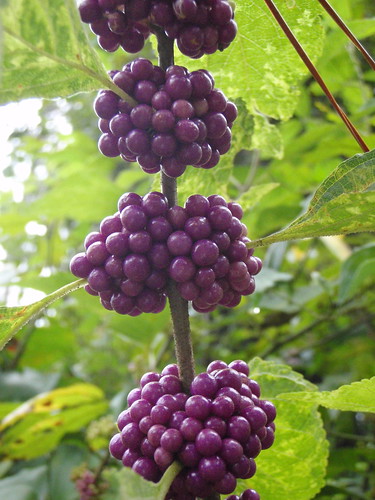
When Forester Wayne Bell of Moultrie pointed it out to me,
he remarked that it was supposed to repel mosquitoes.
Some references say “the shrub, which can grow up to 6 feet”
obviously haven’t seen the ones in our woods, which are well over 10 feet tall.
-jsq