With GM crops come herbicides, which breed resistant weeds.
This has happened in about a decade for the worse mutants.
We can reverse the problem by reversing the spraying,
using plowing, cultivation, and crop rotation instead.
Mark Jeschke wrote for Pioneer Dupont,
Crop Insights: Weed Management in the Era of Glyphosate Resistance,
Herbicide-resistant hybrids and varieties have been planted on a
majority of corn and soybean acres in the U.S. for many years
(Figure 1). The vast majority of these hybrids and varieties are
resistant to glyphosate.
Of course these are mostly not just “hybrids”, they’re GM
seed products with a bacterical gene insereted.
But here’s Figure 1:
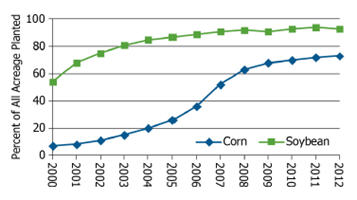
He emphasises how rapidly this chemical dousing of food crops has happened:
The last 15 years can rightly be referred to as the “glyphosate era”
of weed control. Glyphosate rapidly replaced other herbicides in
soybean and by 2002 was used on 79% of soybean acres in the U.S.
(Young 2006). A 2003 survey of Indiana soybean growers found that
glyphosate was the only herbicide applied on 74% of
glyphosate-resistant soybean acres (Johnson et al. 2007) and 65% of
total soybean acres.Adoption was slower in corn, but by 2010, glyphosate had become the
most widely used herbicide in corn as well, with 66% of U.S. corn
acres treated (USDA NASS 2011).Many areas are now transitioning into a post-glyphosate era with
glyphosate-resistant weeds now requiring additional or alternative
management tools for satisfactory control. To date, glyphosate
resistance has been confirmed in 24 weed species worldwide,
including 14 in North America (Heap 2012).
Here’s a handy graph of
number of species resistant to pesticides over time, by
WeedScience.org:
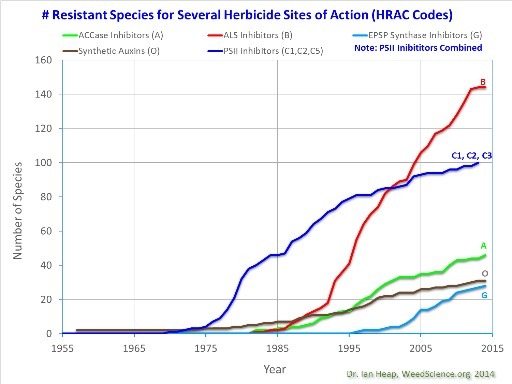
Which line is Glpyphosate, the active ingredient in Monsanto’s Roundup?
According to
Glpphosate Technical Fact Sheet
by National Pesticide Information Center,
In plants, glyphosate disrupts the shikimic acid pathway through
inhibition of the enzyme 5-enolpyruvylshikimate-3-phosphate (EPSP)
synthase. The resulting deficiency in EPSP production leads to
reductions in aromatic amino acids that are
vital for protein synthesis and plant growth.
So, Glyphosate is blue line G, the lowest and most line.
But it only takes one mutant weed.
Andre Gallant wrote for Modern Farmer 18 July 2013,
Pigweed in the Cotton: A ‘Superweed’ Invades Georgia,
In 2004, a farmer spotted palmer amaranth, also known as pigweed,
invading his cotton fields in Macon County, Georgia. Given that
almost all cotton grown in the state is genetically engineered to be
resistant to glyphosate — the main ingredient in Monsanto’s
Roundup herbicide — palmer amaranth’s creep into Georgia
cotton fields meant the weed had built up a resistance as well. And
soon, palmer had spread across the state.Nothing could kill palmer. It can grow to seven feet in height,
drowning out cotton plants and destroying farm equipment. A few
farms lost the palmer battle and closed up shop.No wonder they call it a superweed.
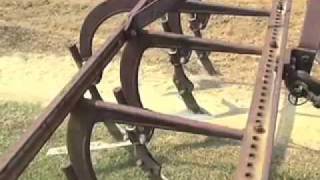
Well, something can kill mutant pigweed:
cold steel.
That article repeats the usual bs about no-till being
“conservation tillage” and then gets on with admitting
that
plowing the pigweed under every year helped a lot.
But the article doesn’t continue about cultivation between
rows, as in this
Georgia Farm Monitor report.
The article instead says:
On top of tillage, farmers increased the amount of herbicides used
on their crops. Before palmer, herbicide costs hovered around $25 an
acre. In palmer’s wake, that amount increased to $100. In addition
to the $15 million spent on labor to hand-weed rows of cotton,
Georgia farmers spent well over $100 million fighting one weed in
one crop.
So much for GM proponents’ claims that GM crops reduce herbicide use.
Another thing that runs up local costs is hiring people to pull up
the mutant pigweed by hand.
Plowing and cultivating seems a lot easier to me.
The article makes a bunch of excuses for why organic cotton
isn’t much grown in Georgia, but doesn’t have any other
solution for mutant pigweed.

Oh, it does get around to talking about winter rye cover crops,
calling it “a culture change”.
How soon they forget!
My father planted winter rye, and so do I.
And he didn’t “burn down” the rye by spraying glyphosate on it, either:
he plowed it under, and so do I.
I don’t grow cotton, but I do grow corn, okra, and other vegetables,
and we have very little pigweed.
And we spray zero, no, zilch pesticides.
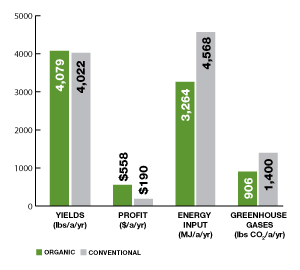
Cotton was king before and may be again now,
but it also fell way off in between as other crops became more profitable.
Maybe it’s time for that in Georgia.
Organic farming of
other crops is indeed booming.
Crop rotation, plowing, cultivating: these things are less expensive
than GM seeds and pesticides, resulting in
more profit.
Oh, and without poisoning the food supply or the water supply.
-jsq
Pingback: N.deG. Tyson falls for the misuse of the authority of science that he decried in Cosmos | Canopy Roads of South Georgia