
Pictures by John S. Quarterman, 28 Oct 2009, Lowndes County, Georgia.
Pictures by John S. Quarterman, 28 Oct 2009, Lowndes County, Georgia.
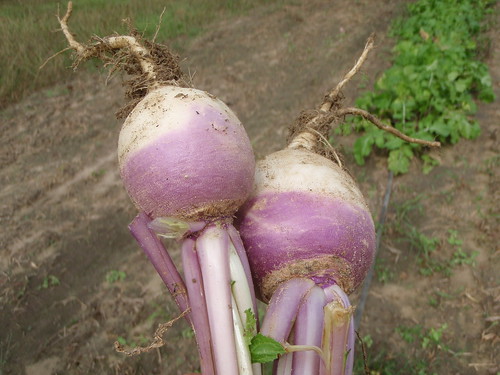
Cook ’em and eat ’em! Continue reading

The Eprida process simultaneously creates value in three markets in this order at today’s prices:I especially like the small scale aspect. Individuals could do this.Unlike other biomass gasification, the Eprida process can operate at small scale, converting waste biomass into fuel and fertilizer. The diesel produced will ultimately be more valuable than ethanol or methanol, and the Eprida process can convert woody plant materials that cannot be cost effectively fermented. Also, unlike virtually all other approaches for biomass to energy, which deplete soil nutrients, the Eprida process restores and enhances soil mineral, carbon and nitrogen content. As a direct result of this new approach to integrated energy and fertilizer production from biomass, the Eprida process effectively removes net CO2 from the atmosphere, and can do so profitably before the value of any carbon credits are even considered.
- Energy: gas-to-liquids diesel, from biomass
- Fertilizer: agricultural soil restoration, carbon enriched with nitrogen
- Carbon Credits: once an agricultural CDM is completed
(And if, like me, you wondered how to pronounce biochar, the ch is like in charcoal.)
Or municipalities like Valdosta or Lowndes County could do this, instead of the current plans for a conventional biomass power plant that looks like it will release more CO2 per kilowatt than a coal plant. Why not go with a homegrown technology that’s cleaner and may also produce diesel as a side effect?
The yellow dog decides to catch it: Continue reading
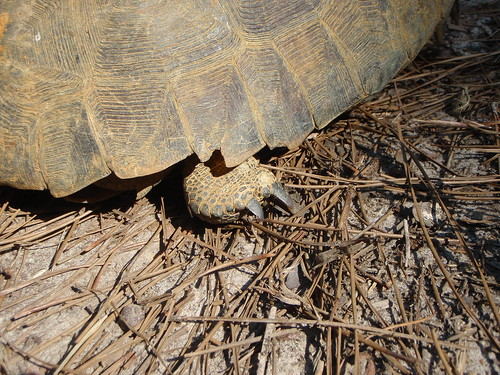
So it could get back to digging.
More pictures in the flickr set.
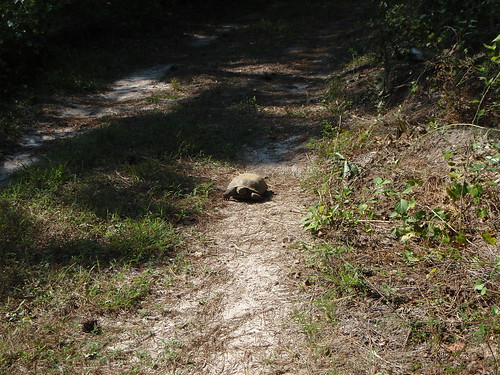
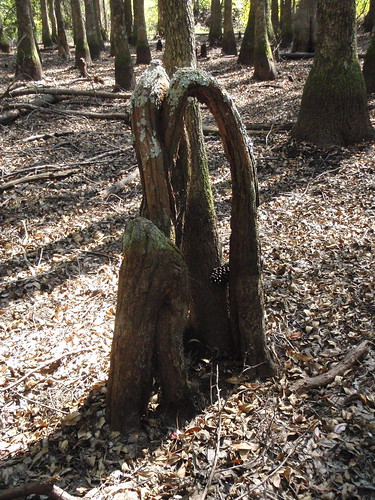
This is the forest primeval.
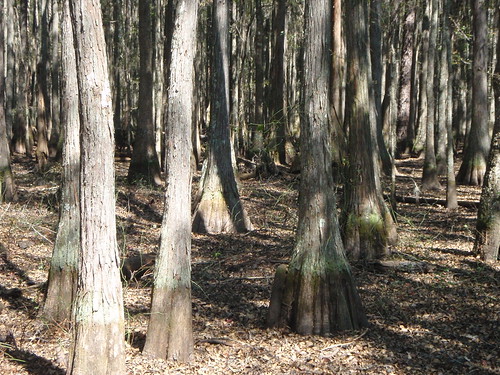
More on flickr.
Pictures by Gretchen Quarterman, 8 September 2009, Lowndes County, Georgia.
In his comments, LaHood tried hard not to criticize Georgia policy makers directly. “I’m not going to pretend to tell Georgia what to do,” he said repeatedly.Ain’t that the truth.But rather than criticize the lack of planning and support for high-speed rail in Georgia, he offered examples of regions elsewhere that “get it.” “The Northeast (high-speed rail) corridor has its act together,” LaHood said. “The Midwest corridor has its act together. The governors there have set aside their own egos and their own ambitions” to work together on bringing high-speed rail to those regions.
LaHood made no mention of the stark contrast to the Southeast, where our governors are too busy posturing to discuss resolution of the ongoing water wars, let alone high-speed rail.
The best part is in a comment:
You see the state legislature wants to control the tax revenues from metro Atlanta so they can spend them in Hahira, Rome, Valdosta, etc., etc. Antwhere but metro Atlanta.Ah, Atlanta! Just more important than anywhere else!
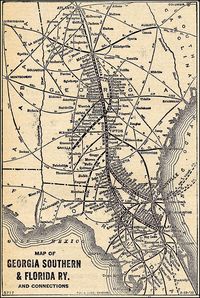 You know, if Atlanta cooperated in creating a rail plan for the entire state,
such as for example the long-established rail corridor from Chattanooga
through Atlanta, Macon, Tifton, Hahira, and Valdosta to Jacksonville and
Orlando, we might actually get rail in Georgia.
It doesn’t have to all be high speed.
If I could take a regular passenger train to Atlanta, I sure would,
instead of having to drive or squeeze into an ASA toothpaste tube.
You know, if Atlanta cooperated in creating a rail plan for the entire state,
such as for example the long-established rail corridor from Chattanooga
through Atlanta, Macon, Tifton, Hahira, and Valdosta to Jacksonville and
Orlando, we might actually get rail in Georgia.
It doesn’t have to all be high speed.
If I could take a regular passenger train to Atlanta, I sure would,
instead of having to drive or squeeze into an ASA toothpaste tube.
By the way, Ray LaHood has a blog.
I noticed this gopher because the dogs kept yipping and running over to where she was. She eventually crawled off into the underbrush and went under, as you can see.
The pictures were taken with a wireless Ethernet camera, recorded by software run out of crontab every minute. The recording ends when it started to rain and I took the camera in.
Pictures by John S. Quarterman, Lowndes County, Georgia, 16 September 2009.
Eastern Box Turtle (Terrapene carolina carolina), a turtle, not a tortoise, yet it lives on land:
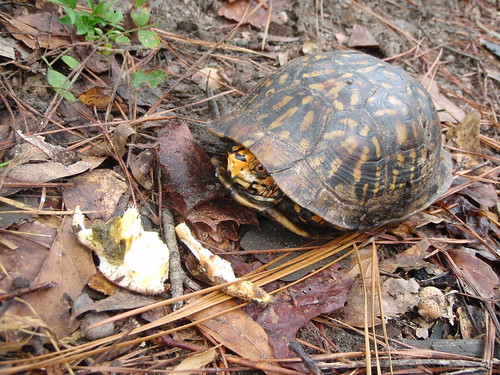
According to the Davidson College Herpetology Lab:
The most widespread subspecies is simply known as the eastern box turtle (T. carolina carolina). This turtle ranges along the entire east coast of the United States from Massachusetts to northern Florida, as far west as the Mississippi River, and north to the Great Lakes. Although this subspecies is highly variable in coloration, it is often more brightly colored than the other subspecies and almost always has four claws on the hind feet.
This one appears to be a male (flattened shell, yellow eyes). Continue reading

A canopy road, in Georgia, with no curbs or gutters. Sure, it doesn’t go anywhere. Neither does Quarterman Road.
Thanks to Bob Clouston for the pointer.