Large as the span of a hand, an insect-eating insect.
They’ll also eat anything else they can catch with their stereo vision, including frogs, lizards, and small birds.
![[Hand-span Mantis]](http://www.okraparadisefarms.com/pictures/2026-07-10--mantis/20260710_173111.jpg)
Gretchen likes mantises.
Blondie is paying no attention. Continue reading
Large as the span of a hand, an insect-eating insect.
They’ll also eat anything else they can catch with their stereo vision, including frogs, lizards, and small birds.
Gretchen likes mantises.
Blondie is paying no attention. Continue reading
This dragonfly repeatedly swooped down to the dog bath water and up.
![[Movie: Dragonfly drinking (34M)]](http://www.okraparadisefarms.com/pictures/2025-07-21--dragonfly-dog-bath/20250721_122312.jpg)
Movie: Dragonfly drinking (34M)
I’m guessing it was drinking.
Maybe this is how they lay eggs? If so, it will be disappointed, since we do change the dog bath water from time to time.
It’s much easier to see the insect in the video:
https://youtu.be/zqUusDsAhpA Continue reading
Beautyberry fruits are setting: the flower petals are falling off and revealing the berries.
Not only are the flowers and berries pleasing violet colors, the leaves repel insects and ticks, and you can make jelly and wine from beautyberries.
![[Beautyberry fruit setting, 2025:06:15 10:36:03]](http://www.okraparadisefarms.com/pictures/2025-06-15--beautyberry/20250615_103603.jpg)
Beautyberry fruit setting, 2025:06:15 10:36:03
Once the berries get some color, you’ll see why it’s called beautyberry. They’re a pleasing violet color. The flowers are an even lighter violet. Also, the whole plant smells good. Continue reading
We were picking blackberries when this skeeter hawk landed on me.
The dragonfly just sat there for many minutes while I picked with my right hand.
Eventually it flew away.
The blackberries are very ripe and tasty.
-jsq
On the truck:
It’s some kind of Mantodea. Probably a native-to-Georgia Carolina Mantis, Stagmomantis carolina. Probably not the larger bird-eating species. These ones eat insects.
Here’s Gretchen observing it. Continue reading
Good thing I looked before walking into the corn:
Those wasps seemed quite at home on that corn leaf. Continue reading
Heather Davis will speak at South Georgia Growing Local 2014:
My presentation will be about how I became interested in honeybees and where my research has led me. It will begin with very basic information about honeybees and how they are important to our ecology. Then I will touch on how the monocultures and industrialized farming, pesticides and GMO/systemic pesticides are killing the bees and our culture and environment as we know it.
I will have pamphlets on GMO’s, how to make your own pesticides/insecticides that are safe for pollinators, what plants to grow to encourage a bio-diverse ecology at home for pollinators and a few others.
She’s on facebook as Sage Apiaries, “Pollination is the future of our food!”
Her conference bio: Continue reading
Blinding:
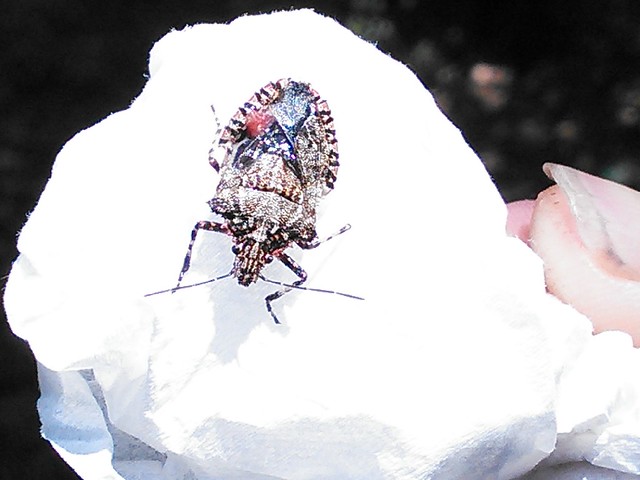
Pictures by John S. Quarterman for Okra Paradise Farms, Lowndes County, Georgia, 11 August 2013.
-jsq
![[Dragonfly and blackberries]](http://www.okraparadisefarms.com/pictures/2024-06-05--dragonfly-blackberries/20240605_183608.jpg)
![[Mantis]](http://www.okraparadisefarms.com/pictures/2021-08-07--mantis/20210807_152046.jpg)
![[Scorpion and Lizard]](http://www.okraparadisefarms.com/pictures/2020-10-17--scorpion-lizard/scorpion-lizard.jpg)
![[Wasps on corn leaf]](http://www.okraparadisefarms.com/pictures/2020-06-29-grapes-corn-wasps/20200629_094437.jpg)
