Tag Archives: Lowndes County

Longleaf sprouts

Found in the gutter:


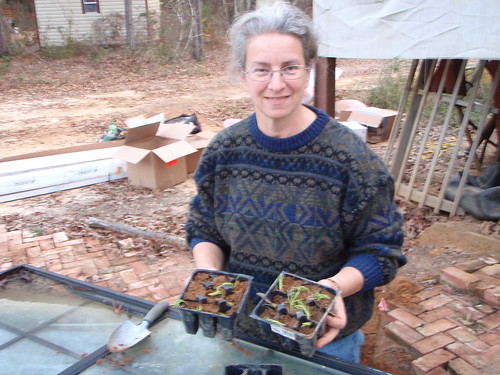
Picture of Gretchen Quarterman holding longleaf sprouts at Okra Paradise Farms
by John S. Quarterman, 19 December 2011.

I found them in the gutter while cleaning oak leaves out of it. Longleaf seeds had sprouted in that wet place. Gretchen stuck them in some dirt in these seedling containers. In a week or so we’ll need to transplant them into something bigger. Their taproots are already almost as deep as these boxes.

We’re also finding quite a few fresh longleaf sprouts in the ground, so apparently we got a pretty good seedfall this year.

-jsq

Burning planted longleaf, 16 December 2011

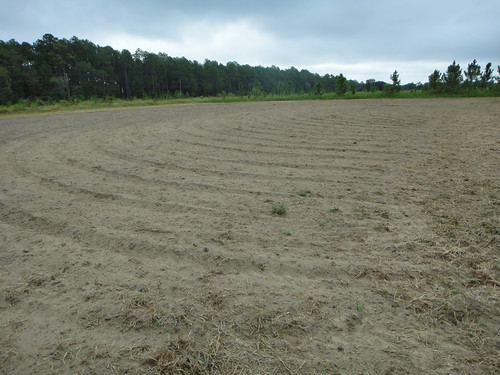
We planted these longleaf three years ago, in 31 January 2009: 12,000 trees we dibbled in by hand. Not even three years old and some of them are 12 feet tall! Every few years they need burning to reduce the weeds like dog fennel and to encourage the native warm season grasses (NWSG). The NWSG burn well: low to the ground, moving right along. The dog fennel not so much, but they do sometimes flare up and make a good show, like this:
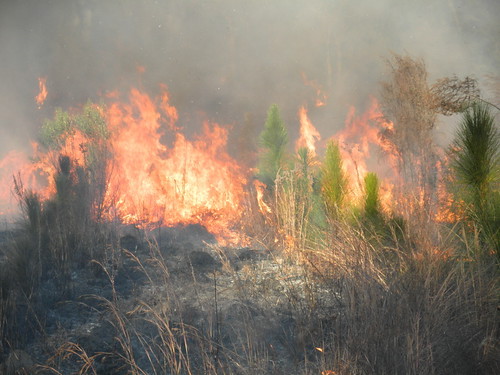

Burning planted longleaf, Okra Paradise Farms, Lowndes County, Georgia.
Pictures by Gretchen Quarterman, 16 December 2011.
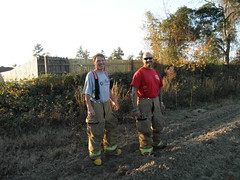
The longleaf themselves are the most fire-resistant of trees. Almost all of these longleaf will survive the fire and thrive. The volunteer loblolly and slash, not so much, and any oaks or other trees even less, so fire favors the longleaf. We had perfect burning conditions: 5-8 MPH wind from the northwest, blowing towards the road.
Some of the subdivision neighbors who are not familiar with prescribed burns called the county fire department. They came out, took one look at the firebreak, and filed a report saying all was OK.

Here’s how the fire got started. Some pyromaniac dribbling fire….

Here’s a slideshow and a playlist of some videos. Continue reading

Beautyberry flowers

Tiny white purplish flowers in a bunch:


Beautyberry (Callicarpa americana) at Okra Paradise Farms
by John S. Quarterman, Lowndes County, Georgia, 4 June 2008.

Growing along the stems of a green-smelling bush: Continue reading

Pair of Pileateds in a Pine Tree

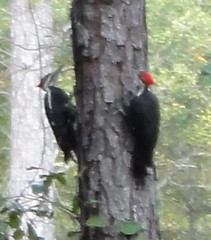
What are these, climbing turkeys? They’re almost big enough.

Or maybe a pair of Southern Pileated Woodpeckers (Dryocopus pileatus) on a longleaf pine (Pinus Palustris).

I got pretty close; they just laughed. Eventually I walked away to do something else, and they flew into another tree directly over my head, where you see them in this video:


Pileated Woodpeckers, Dryocopus pileatus, Lowndes County, Georgia.
Pictures by John S. Quarterman, 7 November 2011.

-jsq

The now unendangered Tennessee Coneflower

Aunt Elsie gets mentioned again for her pioneering career in plant ecology.

According to the Nature Conservancy (undated), Tennessee Coneflower — No Longer Endangered

After years of hard work and the support of many dedicated individuals, an iconic flower is once again thriving in Tennessee. On August 4, 2011, the U.S. Fish and Wildlife Service announced the removal of the Tennessee coneflower from the Endangered Species List, marking an extraordinary recovery from the brink of extinction. The story of the coneflower exemplifies the power of conservation.

In 1968, Vanderbilt biology professor Elsie Quarterman and graduate student Barbara Turner accidentally discovered the fuschia-colored coneflowers at Mount View Cedar Glade. The plant had been thought extinct until the rediscovery. In time, three other coneflower sites were discovered in Davidson and Wilson counties. In 1979, the Tennessee coneflower became one of the first plants to be recorded on the Endangered Species List.

Quarterman subsequently became a trustee of the Tennesee Chapter of The Nature Conservancy and urged the protection of the cedar glade habitats where the Tennessee coneflower and other rare plants have adapted to live in harsh, stony conditions.

Her nephew Patrick found this.

-jsq