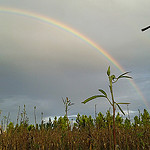
It's a weed, but it doesn't do much harm, and it's blue:
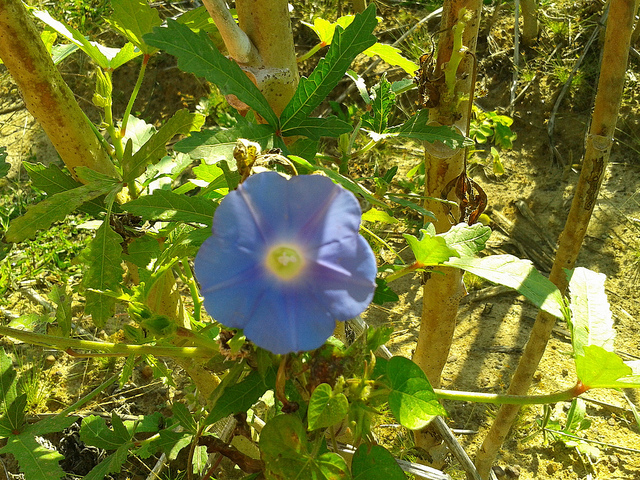
Blooming morning glory in the okra
Picture by John S. Quarterman for Okra Paradise Farms, Lowndes County, Georgia, 26 September 2012.
-jsq
It's a weed, but it doesn't do much harm, and it's blue:
Blooming morning glory in the okra
Picture by John S. Quarterman for Okra Paradise Farms, Lowndes County, Georgia, 26 September 2012.
-jsq
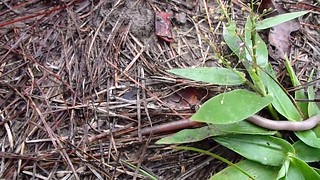
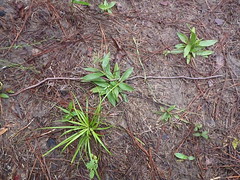
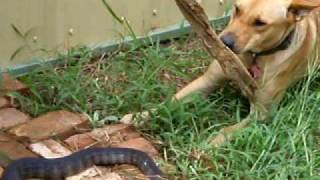
A snakey present from the dogs:

Picture by John S. Quarterman for Okra Paradise Farms, Lowndes County, Georgia, 14 September 2012.
 I like snakes: they eat rodents, and I’m allergic to rodents.
But the dogs don’t like snakes that trespass on their area near the house.
They left this one in the middle of the walkway from the house to the carport.
You see it in the truck on the way to somewhere else.
I like snakes: they eat rodents, and I’m allergic to rodents.
But the dogs don’t like snakes that trespass on their area near the house.
They left this one in the middle of the walkway from the house to the carport.
You see it in the truck on the way to somewhere else.
I think Yellow Dog is nostalgic for her YouTube hit, Black Snake vs. Yellow Dog. They look mild-mannered, Yellow Dog and Brown Dog, but so far a beaver, a raccoon, several rattlesnakes, and two kinds of water moccassins have found tangling with the dogs is not a good idea.
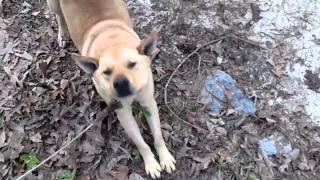 Although that copperhead did give Yellow Dog a bit of a hangover.
Here
Yellow Dog thanks you for your concern.
Although that copperhead did give Yellow Dog a bit of a hangover.
Here
Yellow Dog thanks you for your concern.
-jsq
Terry Davis selected the red kernels last year, planted them this spring, and now he’s picking them.
Here’s a video playlist.
Continue readingGretchen will be selling these sweet potatoes at Valdosta Farm Days tomorrow morning, Saturday, 15 September 2012, 9AM to 1PM, at the historic Lowndes County Courthouse.
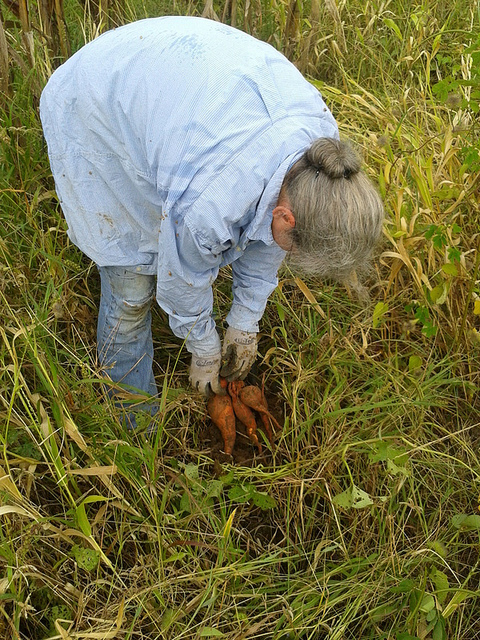
Displaying:
Continue readingThe Withlacoochee River channel was full yesterday at the GA 122 bridge, near Hambrick Road, with reference Yellow Dog:
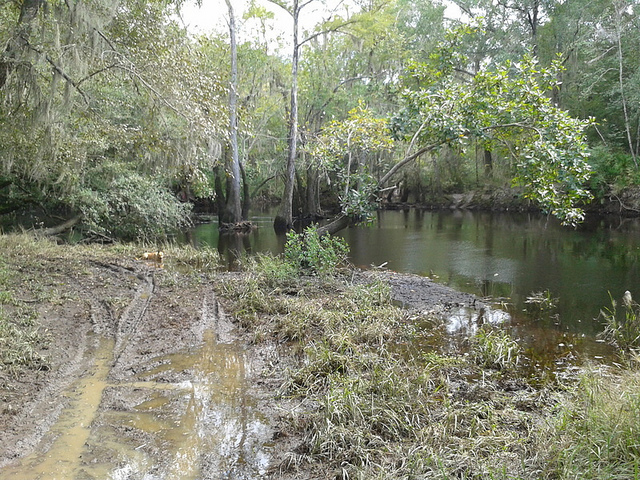
Compare to 21 March 2012 (on the left):
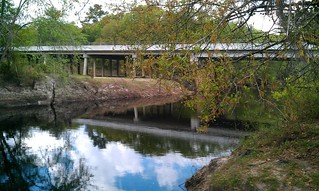
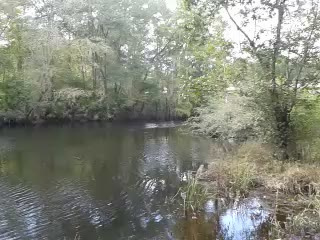
I wasn’t standing in quite the same place yesterday, because I would have been standing in water. But you can see the water is much higher than it was six months ago.
Here are a few more pictures and a video.
-jsq
Who knew fire ants like pumpkins?
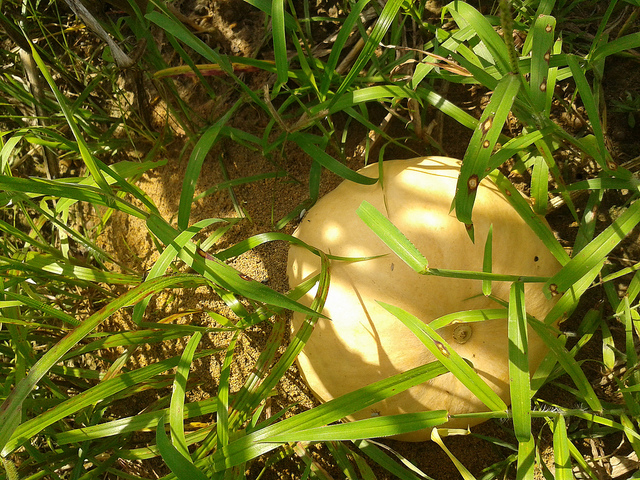
Picture by John S. Quarterman for Okra Paradise Farms, Lowndes County, Georgia, 11 September 2012.
It was ripe, so I rolled it out of the ant bed, brushed off the ants, and we already sold it.
-jsq
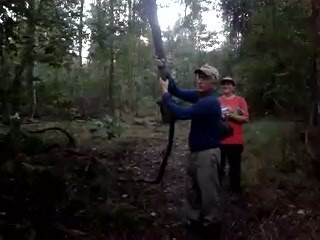 Seeing that grape vine, I said,
Tarzan lives here!
The visiting French botanist gave it a try.
Video by John S. Quarterman for Okra Paradise Farms, Lowndes County, Georgia, 22 August 2012.
Never works for me, but apparently he’s lighter. Watch him go:
Continue readingWe already knew Argentinian farmers were suing Monsanto about Roundup-induced birth defects, including cerebral palsy, down syndrome, psychomotor retardation, missing fingers, and blindness; we knew Roundup’s active ingredient glyphosate was “a risk factor for developing Non-Hodgkin lymphoma”; we knew that Roundup-ready corn causes liver and kidney damage in rats and chickens fed feed including Monsanto corn show abnormal gene expression, and we knew that Roundup-ready corn is toxic to humans. Add to all that: Roundup is a risk for Parkinson’s disease.
Sayer Ji wrote for GreenMediaInfo 18 April 2012, Roundup Herbicide Linked To Parkinson’s-Related Brain Damage,
Continue readingAlarming new research published in the journal Neurotoxicology and Teratology
supports the emerging connection between glyphosate, the active ingredient in Roundup herbicide, and neurodegenerative conditions such as Parkinson’s disease and Parkinsonian disorders.
Published this month (April, 2012), the new study entitled “Glyphosate induced cell death through apoptotic and authophagic mechanisms,” investigated the potential brain-damaging effects of herbicides, which the authors stated “have been recognized as the main environmental factor associated with neurodegenerative disorders, such as Parkinson’s disease.”1
They found that glyphosate inhibited the viability of differentiated test cells (PC12, adrenal medula derived), in both dose-and-time dependent manners. The researchers also found that “glyphosate induced cell death via authophagy pathways in addition to activating apoptotic pathways.”
Roundup herbicide is now a ubiquitous contaminant in our air, rain, groundwater, and food, making complete avoidance near impossible. A growing body of experimental evidence now indicates that it in addition to its neurotoxicity it also has the following.
Modes of Toxicity