Gretchen Quarterman at the
Amtrak Station, Jesup, Georgia, 17 and 25 Feb 2011,
along with a bunch of women from Brunswick on their annual outing to NYC, and around a dozen other passengers.
Videos by John S. Quarterman.
Camano Island is NW of Everett, Washington, and this article is from 2002,
responding to an article in the local paper there. -jsq
Commentary
A Call for Skepticism
by Steven K. Roberts
Camano Island
If ever we needed a demonstration that the fundamental flaw in many
arguments is a lack of discrimination regarding information sources,
we have it in the Nels Konnerup article, “Toxicology 101 Defended,”
in the March 26 issue of the S/C News.
The author makes a “plea for cogent thought, rather than a visceral
reaction to the use of pesticides and herbicides,” and cites a number of
references “authored by highly qualified and respected scientists.” So
far, so good.
But just for fun, I spent a few minutes researching some of these sources
to see if I could determine the affiliations and biases of their authors.
Dr. Stanley Culpepper of UGA Tifton says 52 counties have the mutant pigweed.
He says they’re looking at cover crops and deep turning.
(You may know that as plowing.)
He hastily adds that they’re looking at other herbicides.
But he wraps up by saying we have to look at other methods
than herbicides: tillage and cover crops.
He frames it as diversity and integration.
What it really means is spraying poisons eventually
breeds weeds that refuse to be poisoned.
People, of course,
are not so lucky.
The documentary points out many products in German stores that
include GM soy.
In Argentina, it’s even worse, with increasing numbers of birth defects.
They interview
Prof. Andrés Carrasco about his research on amphibians:
“The hemispheres do not separate, like you can see here.
If you look closely you can see one brain.
Glyphosate can cause this kind of mechanisms, for it is an enzymatic toxin.”
“To human cells glyphosate is already toxic in a very low dose.
A farmer uses a much higher dose on the field.
Roundup is even more toxic than glysophate,
for that is only one of the ingredients in Roundup.”
Roundup says none of this applies to humans and Roundup is safe.
Seralini
says:
Who should you believe?
A corporation repeatedly convicted of deception,
or scientists who say that GM crops
cause liver and kidney damage in animals,
according to research using Monsanto’s own data.
Even as traditional environmentalism struggles, another movement is
rising in its place, aligning consumers, producers, the media and even
politicians. It’s the food movement, and if it continues to grow it may be
able to create just the sort of political and social transformation that
environmentalists have failed to achieve in recent years. That would mean
not only changing the way Americans eat and the way they farm — away
from industrialized, cheap calories and toward more organic, small-scale
production, with plenty of fruits and vegetables — but also altering
the way we work and relate to one another. To its most ardent adherents,
the food movement isn’t just about reform — it’s about revolution.
Food is something that affects everybody, and now that people are
starting to realize that the mainstream food supply is poisoned:
Continue reading →
In honor of Donald Rumsfeld’s memoir, here’s another part of his legacy:
as president of G.D. Searle,
Rumsfeld got the FDA to approve aspartame
(aka Nutra-sweet, Equal, or Canderel),
shortly after Reagan was elected, despite massive evidence that it
caused cancer.
Don’t believe me,
listen to Mike Wallace:
“If Donald Rumsfeld had never been born think of how many millions of
people the world over would not suffer headaches and dizziness. Thousands
blind from the free methyl alcohol in aspartame would have sight,
and there would be much fewer cases of optic neuritis and macular
degeneration. Millions suffering seizures would live normal lives and
wouldn`t be taking anti-seizure medication that won’t work because
aspartame interacts with drugs and vaccines. Think of the runner, Flo
Jo, who drank Diet Coke and died of a grand mal seizure. She, no doubt,
would still be alive. Brain fog and memory loss, skyrocketing symptoms
of aspartame disease, would not be epidemic.”
What’s not opinion is that aspartame includes methyl acohol and other
toxic and carinogenic chemicals.
Clothianidin has already been banned by Germany, France, Italy, and
Slovenia for its toxic effects. So why won’t the EPA follow? It probably
has something to do with Big Agra, who loves the stuff for treating the
corn seed supply.
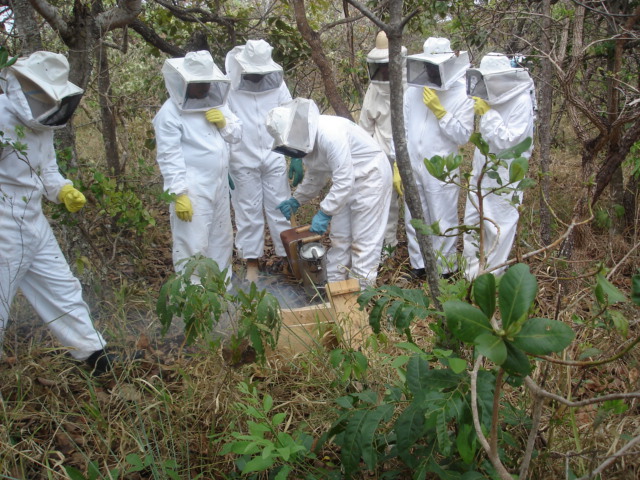
The world honey bee population has plunged in recent years, worrying
beekeepers and farmers who know how critical bee pollination is for
many crops.
She includes a quote from the study:
Clothianidin’s major risk concern is to nontarget insects (that is,
honey bees). Clothianidin is a neonicotinoid insecticide that is both
persistent and systemic. Acute toxicity studies to honey bees show that
clothianidin is highly toxic on both a contact and an oral basis. Although
EFED does not conduct RQ based risk assessments on non-target insects,
information from standard tests and field studies, as well as incident
reports involving other neonicotinoids insecticides (e.g., imidacloprid)
suggest the potential for long-term toxic risk to honey bees and other
beneficial insects.
 Waiting, boarding, and watching it go after the return:
the train at Jesup.
Waiting, boarding, and watching it go after the return:
the train at Jesup.