I wanted to remember what it was like before it got paved so I took this video.
-gretchen
-gretchen
Gretchen and I burned some woods the last couple days. Here’s why we burn: longleaf pine unharmed, while small trees of other species (slash and loblolly pine, an especially oaks) are weeded out by the fire.
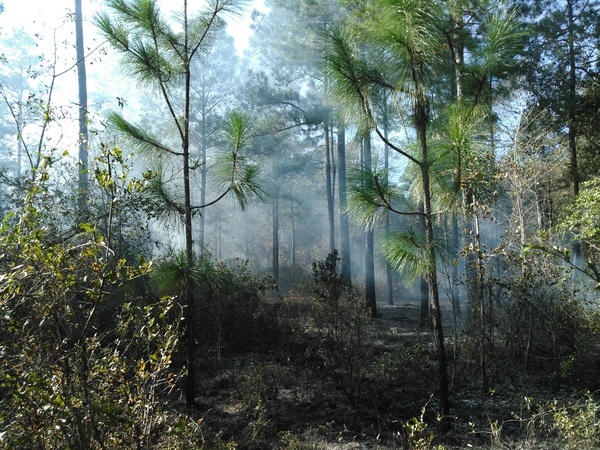
Click on any picture for a bigger one. -jsq
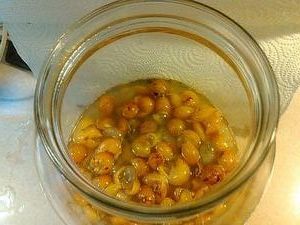 Small, growing, ripe, picked, and now Gretchen is fermenting them: native Scuppernong Muscadine grapes (Vitis rotundifolia).
Very tasty!
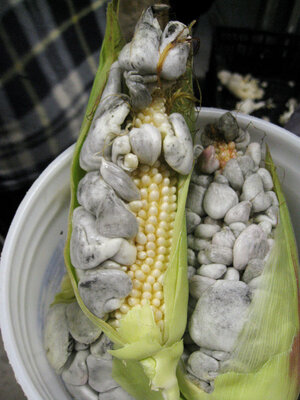
Corn smut a delicacy? Well, if truffles can be, why not?
 Jill Neimark, the salt, 24 August 2015,
Scourge No More: Chefs Invite Corn Fungus To The Plate,
Jill Neimark, the salt, 24 August 2015,
Scourge No More: Chefs Invite Corn Fungus To The Plate,
One evening last July, Nat Bradford walked along rows of White Bolita Mexican corn at his Sumter, S.C., farm, and nearly wept. All 1,400 of the corn plants had been overtaken almost overnight by corn smut, recalls Bradford, who’s also a landscape architect. The smut, from a fungus called Ustilago maydis, literally transforms each corn kernel into a bulbous, bulging bluish-grey gall. It is naturally present in the soil and can be lofted easily into the air and onto plants.
Smut is considered a scourge by most U.S. farmers, and it goes by the nickname “devil’s corn.” Just one discolored kernel typically renders an ear completely unsellable….
Yep, that’s the way we’ve usually considered it. But keep reading: Continue reading
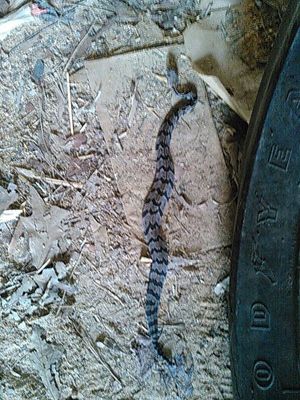 No rattles, didn’t coil, seemed like a harmless little oak snake.
No bigger than from the O to the A in GOODYEAR (less than two feet long). Continue reading
No rattles, didn’t coil, seemed like a harmless little oak snake.
No bigger than from the O to the A in GOODYEAR (less than two feet long). Continue reading
2011 inductee, Tennessee Botanists Hall of Fame, Elsie Quarterman,
Elsie Quarterman was born in 1910 in Georgia. She completed her undergraduate work at Georgia State Woman’s College in 1932. Post-graduate studies were done at Duke Univ. where she obtained her Ph.D. in 1949 under Henry J. Osting. She accepted a faculty position at Vanderbilt Univ. and later became the University’s first female department chair, heading the Biology Department in 1964.
Dr. Quarterman is best known for her work on the ecology and plant communities of the cedar glades of the Central Basin. She is widely recognized for the re-discovery of the Tennessee Coneflower (Echinacea tennesseensis) in 1969, a plant once thought to be extinct and subsequently the first plant endemic to Tennessee to be protected by the Endangered Species Act. She has received many honors including our very own TNPS Conservation Award. The Elsie Quarterman Cedar Glade State Natural Area was named in her honor in 1998.
-jsq
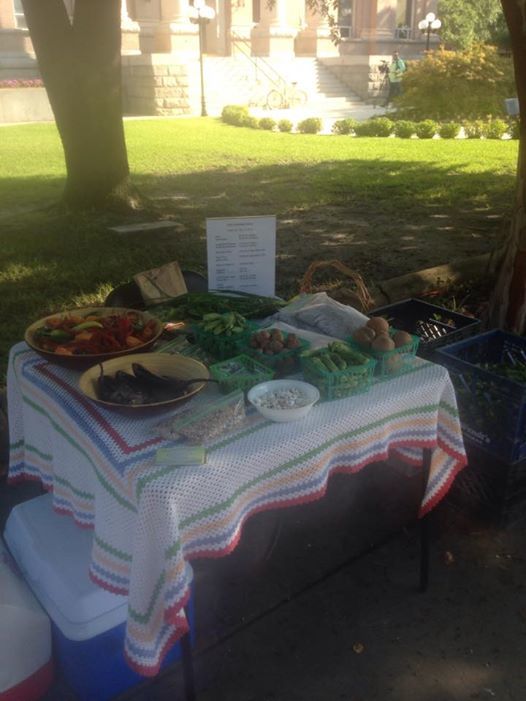
Also rosemary, collard seeds…. A bit muggy, you can tell by the foggy picture Gretchen just took at the historic Lowndes County Courthouse in downtown Valdosta, Georgia.
-jsq
 Red-shouldered hawks, split-tailed kites, and buzzards were riding the updrafts mid-day today.
You can also hear bluebirds and other birds keeping to the trees.
Red-shouldered hawks, split-tailed kites, and buzzards were riding the updrafts mid-day today.
You can also hear bluebirds and other birds keeping to the trees.
Here’s a video playlist. Continue reading
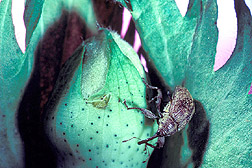
Because Genetically modified crops risk widespread ruin, they should not be permitted without far greater scientific knowledge, for which the burden of proof falls on those proposing GMOs, not those opposing, say experts in risk and ruin.
 Risk management or mitigation may work for localized harm,
but GMOs risk widespread systemic damage, which is ruin, and to prevent that
the precautionary principal is needed:
Risk management or mitigation may work for localized harm,
but GMOs risk widespread systemic damage, which is ruin, and to prevent that
the precautionary principal is needed:
if an action or policy has a suspected risk of causing severe harm to the public domain (such as general health or the environment), and in the absence of scientific near-certainty about the safety of the action, the burden of proof about absence of harm falls on those proposing the action.
A paper by Nassim Nicholas Taleb and co-authors lays out Continue reading
 Really on the air this morning, and now on YouTube,
talking about “quite the event” as Chris Beckham called it,
South Georgia Growing Local, this Saturday, January 24th at Pine Grove Middle School, in Lowndes County, Georgia.
Five times five: five tracks in five sessions, from
soil to planting to cooking and nutrition, including aquaponics by UGA Professor Pat Duncan and local oils
by national award winner Clay Oliver.
Space still available; sign up now!
Really on the air this morning, and now on YouTube,
talking about “quite the event” as Chris Beckham called it,
South Georgia Growing Local, this Saturday, January 24th at Pine Grove Middle School, in Lowndes County, Georgia.
Five times five: five tracks in five sessions, from
soil to planting to cooking and nutrition, including aquaponics by UGA Professor Pat Duncan and local oils
by national award winner Clay Oliver.
Space still available; sign up now!
Video by Gretchen Quarterman for Okra Paradise Farms (OPF).
-jsq